
Most players have no consistent strategy for vulnerable made hands on the turn.
They barrel sometimes. They check sometimes. And most of the time, it comes down to gut feel rather than any real logic. That’s a leak worth fixing.
Let’s walk through a common turn spot and build a simple rule you can actually use. Push play, and/or continue reading…
The Turn Situation
You’re on the button. You raise preflop, the big blind defends. Heads up. The flop comes Q94 rainbow. Villain checks, you c-bet, they call. The turn is an Ace, and they check to you again.
Now the question: what do you do if you’re holding 22? 77? QT?
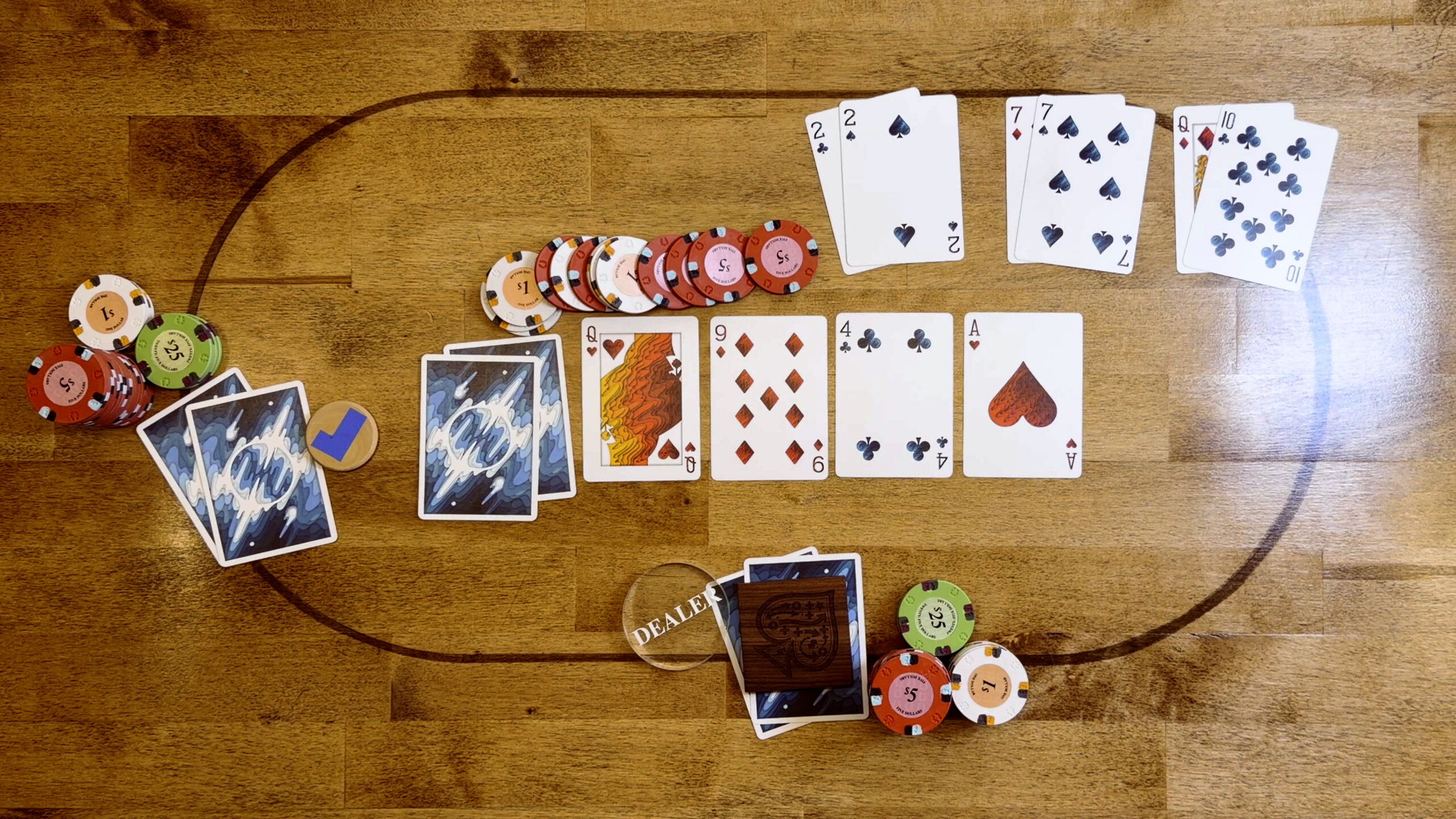
Most players stall here. And that’s exactly the problem.
What Makes A Hand Vulnerable
A vulnerable made hand is one that’s probably ahead right now but faces a lot of bad futures. Bad runouts. Bad actions. Cards or bets that flip the situation against you.
22 on this board is a clear example. Almost every river card is going to be higher than your pair. If you face a big bet or raise at any point, you’re in rough shape. And even now, you’re behind any bottom pair.
That’s vulnerable.
What The Solver Actually Does
This is where it gets interesting. When you look at GTO bluffing output for 22 in this spot, it bets about 33% of the time. Sometimes with larger sizes.
But it never barrels 77 here. In fact, it checks 66, 77, and 88.
Why? Because those hands are simply less vulnerable than lower pairs. The solver has constraints on how often it can bet in this situation, mostly to stay balanced. But here’s the key: you’re not a solver, and your opponents aren’t either.
Unless your opponent is capable of raising your turn barrels at an accurate frequency (which most low-stakes players are not), you can profitably bet all your pairs 88 and below for protection.
The Two Mistakes Your Opponents Are Making
Most opponents in this spot are doing one of two things. They’re either over-folding to your bets, or they’re under-raising when they should be fighting back. Against both tendencies, barreling your vulnerable pairs for protection is the right play. Your winrate goes up in both cases.
The one exception: if you happen to be against the rare player who raises turn bets hyper-aggressively, wide protection bets become a problem. You’re building a pot with a hand that can’t stand a raise. That’s when checking makes more sense.
The Non-Vulnerable Side Of The Equation
QT on this board is not a vulnerable hand. It has real equity. It can bluff-catch rivers. The solver bets it some of the time, mostly for balance. But you can check it back with the intention of bluff-catching, and you lose very little in the process.
This is the other half of the adjustment. Check your mid-strength non-vulnerable holdings more often. Let them play as bluff-catchers on later streets. They don’t need the fold equity now.
At the same time, you can also check your absolute weakest holdings. Hands at the bottom of your range don’t benefit from building a pot. Check those too.
The result is a betting frequency that is actually pretty close to the solver’s, but somewhat skewed toward stronger holdings.
While this departs slightly from perfect balance, these weakest hands do not benefit from building the pot, and the practical upside of concentrating aggression in hands that gain the most from protection outweighs the theoretical cost of being mildly unbalanced.
Putting It Together
After all these adjustments, your overall betting frequency ends up looking similar to the solver. But the composition of your betting range has shifted. You’re now betting the hands that actually benefit from protection. And you’re checking the hands that don’t need to bet to realize their equity.
Bet more aggressively with vulnerable pairs. Check more often with non-vulnerable mid-strength hands that can bluff-catch later. Check the absolute bottom of your range.
That’s the framework.
The Simple Rule
If you have a vulnerable pair on the turn and your opponent is not raising enough, or is folding too often, barrel it for protection more often than theory suggests.
That’s it. One if/then statement you can apply in real time.
This concept is covered in depth as Exploit #20 in The Low-Stakes Poker Playbook alongside 98 other exploitative plays built for the opponents you actually face at $1/$2 and $2/$5.